Vulnerability beneath the waves
Who will monitor subsea infrastructure as it grows in scale and importance?

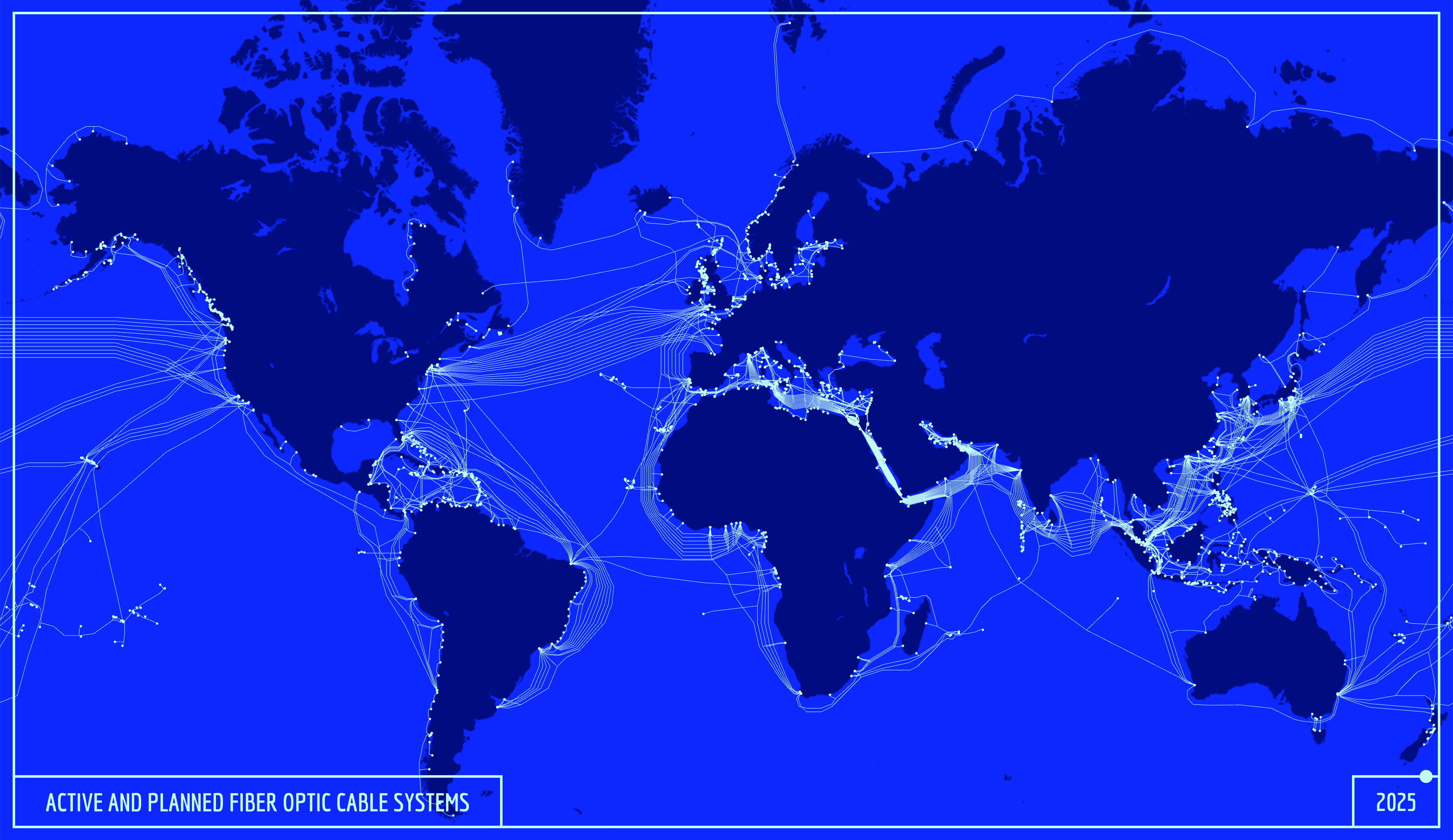
When people think about the internet, they picture the sky: satellites and the cloud. But the true backbone of global connectivity runs along the seafloor. More than 97% of global data flows through millions of kilometers of subsea cables.
This weekend, the soft underbelly of worldwide communication was exposed once again. Cuts to subsea cables in the Red Sea disrupted internet services from India to the Middle East. Microsoft’s Azure cloud had to reroute traffic to keep services alive, while entire countries experienced latency spikes. This incident’s connection to Microsoft drew attention to rising subsea vulnerability but the reality is failures occur more frequently than we realize.
The Red Sea and West Africa were struck by coordinated cuts in 2024. A volcanic eruption severed Tonga’s only international cable for weeks, Baltic Sea cables were sabotaged by Russian ships dragging anchors, and suspicious Taiwan cable cuts left Matsu Island disconnected for weeks. Each outage underscored the fragility of the digital economy’s backbone. These disruptions come as hyperscalers and tech giants pour unprecedented capital into subsea infrastructure. Meta announced Project Waterworth in 2024: a $10B subsea cable spanning 50,000 kilometers. Google has invested in 30 subsea cables since 2010, including a new $1B project connecting the U.S. to Japan.
Subsea infrastructure, vital to everything from AI to energy, is still inspected much as it was decades ago. Vessels with day rates upwards of $100K and skilled crews, both in short supply, are dispatched to operate tethered submersibles. The result is manual, costly, and reactive point inspections that are only possible in limited weather windows. When a cable is cut, operators piece together fragmented clues like service slowdowns and sparse sensor data to estimate fault location and then send ships to collect visual data needed for repair planning. Yet there are only 22 aging repair ships worldwide with backlogs at all-time highs. More than 30 days can pass before a repair ship is even dispatched, and full restoration can take months.
Advances in compute efficiency, AI, and communications open the door to autonomous systems that can safeguard this critical infrastructure in real-time. But existing AUVs (autonomous underwater vehicles) are hamstrung by their legacy architectures: they dive on pre-planned routes, collect data in isolation, and must resurface for hours of post-processing before any actionable intelligence can be parsed. These limitations have kept them from displacing legacy ship-centric operations, leaving operators blind at the moments when rapid threat detection matters most.
Subsea industries require solutions that can keep operators in the loop with live data and intelligent adaptability. At Thalassa Robotics, we seek to make predictive maintenance and threat deterrence the norm in the subsea domain. Follow us in the coming months to see how our novel approach to subsea swarming with wireless, high-bandwidth communication will bring real-time visibility and security to a domain where it’s long overdue.